The Complete BRRR Strategy Guide for 2026: How to Recycle Your Capital
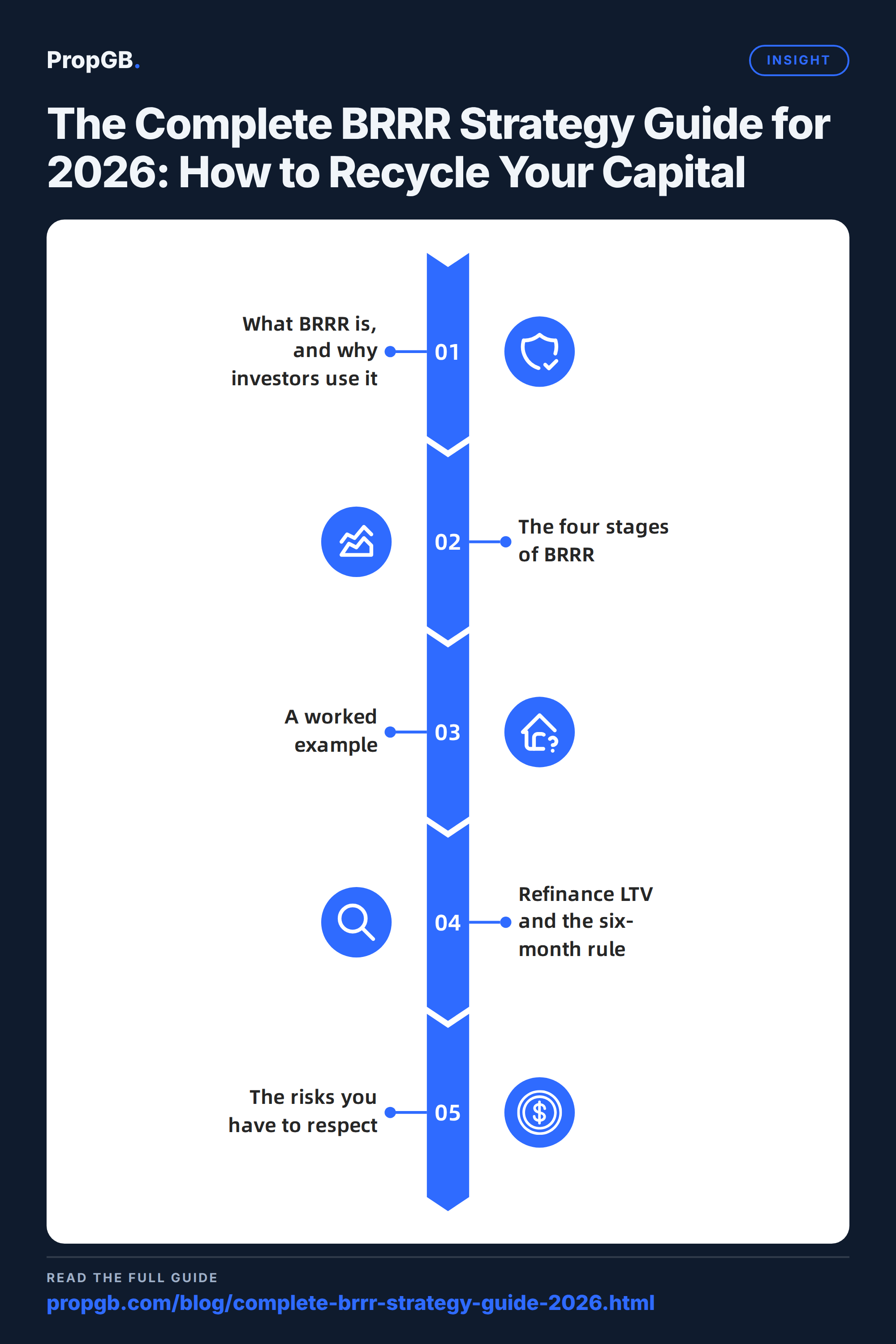
BRRR stands for Buy, Refurbish, Rent, Refinance, a strategy where you buy a property below market value, improve it, let it to a tenant, then refinance against the new higher value to pull most of your money back out. Done well, you recover the bulk of your capital and recycle it into the next purchase, so the same pot of cash buys you property after property instead of being locked into a single deal.
That is the whole appeal: capital efficiency. Below we walk through what each stage actually involves, a full worked example with real numbers, what "capital left in" and "money recycled" mean, how refinance loan-to-value and the six-month rule work, and the risks that can quietly turn a good BRRR into a bad one.
What BRRR is, and why investors use it
A standard buy-to-let leaves your deposit, fees and stamp duty tied up in the property for years. BRRR is designed to break that constraint. By buying cheaply and adding value, you create equity that you can then borrow against, recovering most of your cash so you can repeat the process. It is the engine behind many fast-growing portfolios, and it works best when you can buy genuinely below market value and improve the property meaningfully.
BRRR is not about being lucky with the market. It is about manufacturing equity yourself, through the purchase price and the refurbishment, so you do not have to wait years for growth to give you your money back.
The four stages of BRRR
1. Buy
Everything starts with buying below market value. The discount at purchase is your margin of safety, so this stage is really a sourcing challenge, finding motivated sellers, run-down stock or off-market opportunities. If you pay full price, there is no room to refinance your money out later. Many BRRR investors buy with cash or short-term bridging finance, because tired properties often will not qualify for a standard mortgage until they are improved.
2. Refurbish
The refurbishment is how you push the property's value up. That might mean a full renovation, a new kitchen and bathroom, reconfiguring the layout, or modernising a dated but structurally sound house. The aim is to spend money where it adds more value than it costs, and to lift the property to a standard that both commands strong rent and supports a higher valuation. Accurate costing here is critical, overspend, and your trapped capital grows.
3. Rent
Once the works are finished, you let the property to a tenant. A let property with a strong, evidenced rent is far easier to refinance than an empty one, because lenders assess buy-to-let affordability against the rent. A good tenant in place also starts the cashflow that funds the holding costs. Check the achievable rent with our rental yield calculator before you commit, so you know the income will support the new mortgage.
4. Refinance
This is the stage that makes BRRR what it is. You take out a new mortgage based on the property's improved value, repay any bridging or cash you used to buy and refurbish, and release the difference. The higher the new valuation and the higher the loan-to-value you can borrow at, the more of your original capital comes back to you, ready to recycle into the next deal.
A worked example
Numbers make this concrete. Take a typical small BRRR project:
- Purchase price: £120,000
- Refurbishment cost: £35,000
- Total invested (ignoring fees for simplicity): £155,000
- Gross development value (GDV) after works: £200,000
- Refinance at 75% loan-to-value: £150,000 released
So you put in £155,000 across the purchase and the refurbishment. The finished property is valued at £200,000. You refinance at 75% LTV, which gives a new mortgage of £150,000. That £150,000 repays the cash you used, leaving just £5,000 of your original money still in the deal, and you now own a £200,000 asset, let to a tenant, with roughly £50,000 of equity behind the 75% mortgage.
Capital left in vs money recycled
Those two phrases are the heart of BRRR. Money recycled is the cash the refinance hands back to you, £150,000 in the example, almost all of what you put in. Capital left in is what you cannot get back out: the £5,000 gap between your £155,000 total cost and the £150,000 released. The smaller the capital left in, the closer you are to a "no money left in" deal, where you have effectively recovered everything and can move straight on to the next project. If the numbers had been a little worse, a lower GDV, or higher refurb costs, you would simply leave more capital trapped in the deal.
Because these figures interact in ways that are easy to get wrong in your head, model them properly before you buy. Our BRRR calculator lets you plug in the purchase price, refurbishment cost, GDV and refinance LTV and shows you exactly how much capital you would leave in and recycle, plus the cashflow once the new mortgage is in place.
Refinance LTV and the six-month rule
The loan-to-value you can refinance at directly controls how much you release. At 75% LTV the lender will advance 75% of the valuation; a higher value or a higher permitted LTV means more cash back. This is why an accurate, defensible GDV matters so much, your whole return hinges on the surveyor agreeing with your figure.
Timing matters too. Many lenders have historically required you to own a property for at least six months before they will refinance against its current market value rather than your original purchase price, the so-called six-month rule. Some lenders now offer day-one remortgages that consider the improved value sooner, but criteria vary widely. Always confirm a specific lender's stance with your broker before you build a deal around an early refinance.
The risks you have to respect
BRRR is powerful, but it concentrates several risks into one project. Go in with your eyes open.
- Down-valuation. The single biggest risk. If the refinance valuation comes in below your GDV, you release less and leave more capital trapped. Protect against it by using conservative, evidence-backed comparable values rather than optimistic ones.
- Refurbishment overruns. Hidden problems, scope creep and rising material or labour costs can blow a budget. Always carry a contingency, and price the work properly before you commit, not after.
- Interest-rate rises. A higher rate at refinance squeezes your cashflow and the amount you can borrow, because affordability is tested against the rent. Stress-test the finished deal at a higher rate than today's so it still works if rates move against you.
- Finance and timing risk. Bridging finance is expensive and time-pressured. Delays to the works or the refinance eat into your margin, so a realistic timeline matters as much as the headline numbers.
Who BRRR suits
BRRR rewards investors who are comfortable managing a refurbishment, can source genuinely discounted stock, and have the cash or finance to fund a purchase and works before the refinance returns it. It is more hands-on and higher-risk than a straightforward buy-to-let, and it does not suit anyone who needs their capital to stay liquid in the short term. But for investors who want to grow a portfolio without needing a fresh deposit for every property, it is one of the most effective strategies there is.
Two things make or break it: buying well and valuing conservatively. The buying side is a sourcing discipline, our guide to the best deal sourcing strategies for 2026 covers how to find the below-market properties that BRRR depends on. And because the strategy leans on refinancing rather than market growth, it is worth understanding the wider backdrop too, which we set out in our May 2026 market update.
Putting it together
A clean BRRR follows a simple logic: buy below market value, add value through a well-costed refurbishment, let the property to evidence the rent, then refinance at a sensible LTV against a defensible valuation to recycle your capital. Get each stage right and you keep the capital left in small and the money recycled large. Get the GDV or the refurb wrong and the maths quietly turns against you. The discipline is in the modelling, so build the deal on paper, stress-test it, and only commit when it still works under conservative assumptions.