Mining Searches: Why CON29M Matters in Former Coalfield Areas
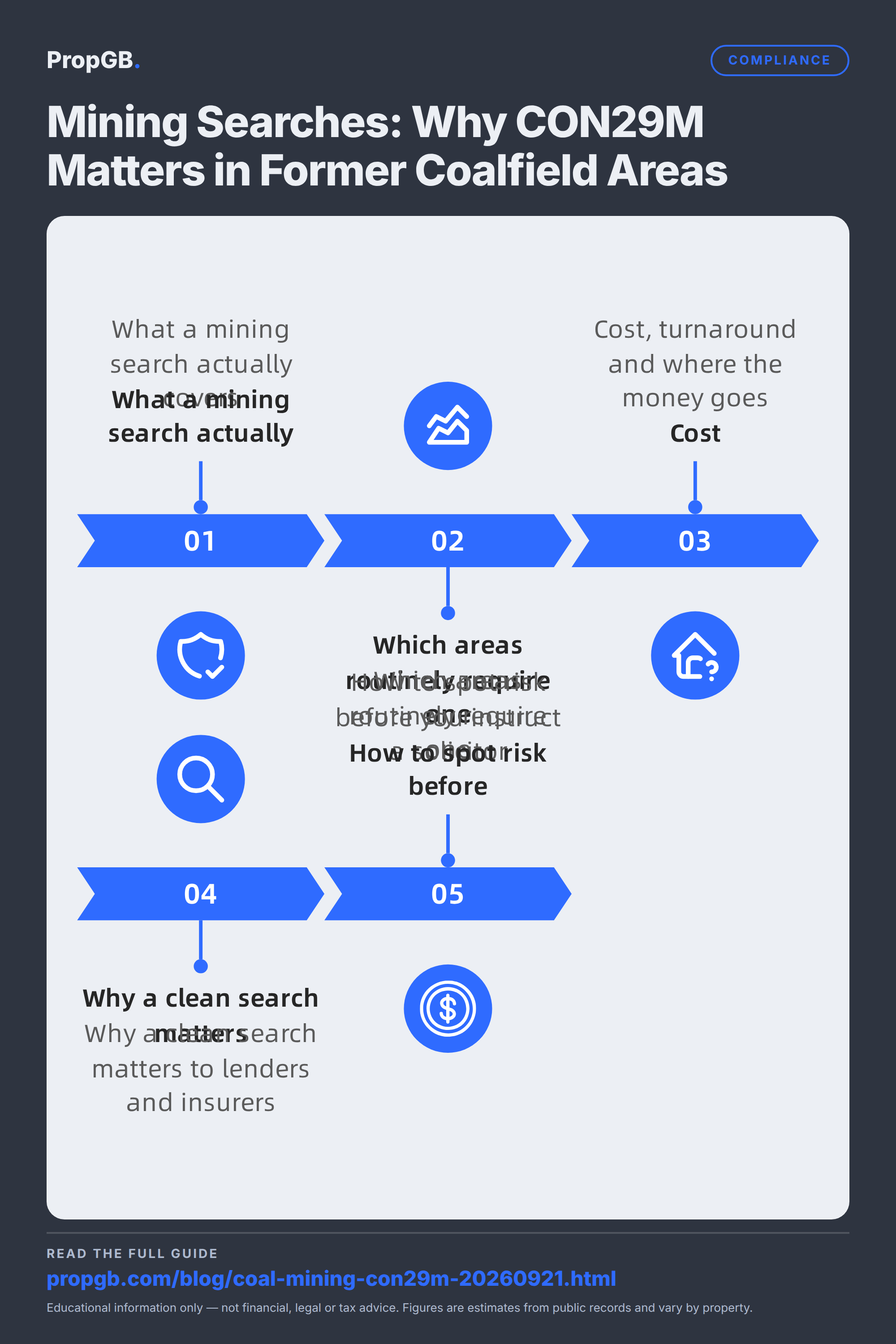
A mining search is a property-specific enquiry into historical and current underground coal mining activity affecting a site and its immediate surroundings. In former coalfield areas it is treated as a standard search, ordered alongside the local authority and drainage enquiries, because coal workings can cause subsidence, gas migration and unstable ground that a routine conveyancing pack will not reveal. The result is a report — commonly known as a CON29M — that a lender, and often an insurer, will expect to see before a mortgage or policy is issued.
What a mining search actually covers
The search examines the property against records of coal mining activity, both past and present. It typically reports whether the site sits within a defined coal mining area, whether seams have been worked beneath or adjacent to it, and whether shallower workings or outcrops are recorded nearby.
Beyond the simple presence of workings, the report addresses the practical consequences. It will flag recorded subsidence damage, shaft and adit locations, spoil heaps, and any current or historic licence or abandonment plans that touch the site. Where a claim for damage has been made, the report may note the outcome and whether remedial works were recorded.
The report also distinguishes between areas where coal is present but unworked and areas where extraction has actually taken place. That distinction matters: an unworked seam is a very different proposition from a seam that has been removed and left voids that may or may not have been stabilised.
Which areas routinely require one
Mining searches are not ordered everywhere. They are a standard requirement across the recognised coalfield regions, where the local authority or the relevant coal authority holds records of extraction. In practice this covers large parts of the Midlands, the North of England, South Wales, the Scottish central belt and parts of Kent.
Whether a specific property needs one depends on its location rather than its type. A flat, a terraced house, a commercial unit and a development site can all fall inside a defined mining area, and the requirement follows the land, not the building. Postcode alone is not a reliable guide, because coalfield boundaries are irregular and can cut through a single street.
Some lenders apply the requirement as a condition of the mortgage offer, meaning the search must be satisfactory before funds are released. Others ask for it only where the valuer raises a concern. A buyer or landlord should confirm the position with the lender and the relevant authority for the specific property rather than assuming a national rule applies.
Cost, turnaround and where the money goes
A mining search is a modest disbursement compared with the overall cost of conveyancing, and it is usually ordered by the solicitor as part of the standard search bundle. Turnaround is typically measured in days rather than weeks, though it can extend where the enquiry requires manual interrogation of historical plans.
The fee is not retained by the solicitor. It is passed to the body that maintains the mining records and issues the report, which is why the charge appears as a disbursement on the completion statement. In some regions the search is handled by the local authority; in others it is handled by the coal authority or an authorised provider operating under licence.
Because the fee is set by the record holder rather than the conveyancer, it is not usually negotiable. A buyer should expect to see it itemised separately, and should ask for the report itself rather than a summary line on a completion statement.
| Element | What to expect |
|---|---|
| Who orders it | Usually the buyer's solicitor, as part of the standard search pack |
| Who issues it | The body holding the mining records for that area |
| How it is charged | As a disbursement, passed through at cost |
| Typical turnaround | Days, extending where manual record checks are needed |
| Who relies on it | Buyer, lender and, where relevant, the insurer |
Why a clean search matters to lenders and insurers
A lender's security is the property itself. If the ground beneath it is unstable, or if there is a recorded history of subsidence, the value of that security is harder to assess and the risk of future damage is harder to price. A satisfactory mining search gives the lender a documented basis for proceeding.
Insurers take a similar view. Standard buildings policies often exclude or restrict cover for subsidence and ground movement, and a known mining history can affect both the availability and the terms of cover. A clean search helps establish that the property is not in a recorded affected area, which supports a standard policy rather than a specialist one.
For a landlord, the search also feeds into the ongoing obligations of ownership. If a property sits in a mining area, there may be notification requirements or access rights connected to the mining records, and these can affect what can be built, planted or excavated on the land. The search is the document that surfaces those constraints early.
It is worth being precise about what a clean search does and does not mean. It indicates that no relevant mining features are recorded against the property at the time of the enquiry. It is not a structural survey, and it does not certify that the ground is stable. It is a records-based check, and its value lies in what the records show.
How to spot risk before you instruct a solicitor
A buyer can do useful groundwork before any search is ordered. The first step is to check whether the property falls within a defined coalfield area, using the published coalfield boundary information for the region. This is a location check, not a property check, and it narrows the question quickly.
The second step is to look at the physical evidence. Older terraced streets in mining areas sometimes show stepped or cracked brickwork, uneven door frames, patched render or repaired garden walls. These are not proof of mining subsidence, but they are a prompt to ask the seller directly whether any movement has been recorded or remediated.
The third step is to ask the seller and the agent a direct question in writing: has a mining search been carried out on this property, and is a copy available? A previous report, even an older one, gives the solicitor a starting point and may reveal whether the site has already been assessed.
- Check the published coalfield boundary for the region before viewing.
- Note any visible cracking, patching or uneven ground around the property.
- Ask the seller in writing whether a prior mining search exists.
- Check whether neighbouring properties have had remedial or stabilisation works.
- Confirm with the lender whether the search is a condition of the mortgage offer.
None of this replaces the formal search. It simply means that when the solicitor orders it, the buyer already understands why it is being asked for and what a problematic result might mean for the transaction.
What to check next
Confirm with the relevant authority for the specific property whether it falls within a defined mining area, and ask which body holds the mining records for that location. Request the full search report rather than a summary, and read the section on recorded workings, shafts and subsidence claims rather than relying on the headline result.
Ask the lender in writing whether a satisfactory mining search is a condition of the mortgage offer, and ask the insurer whether the property's mining status affects the terms of cover. If a report has already been produced, check its date and whether it predates any recent development on or near the site.
Finally, compare the search result against the physical condition of the property and any structural survey findings. Where the records and the visible evidence point in different directions, take advice from a qualified professional before exchange. The position must be confirmed with the relevant authority for the specific property.