The UK Property Market in 2026: What the Data Shows
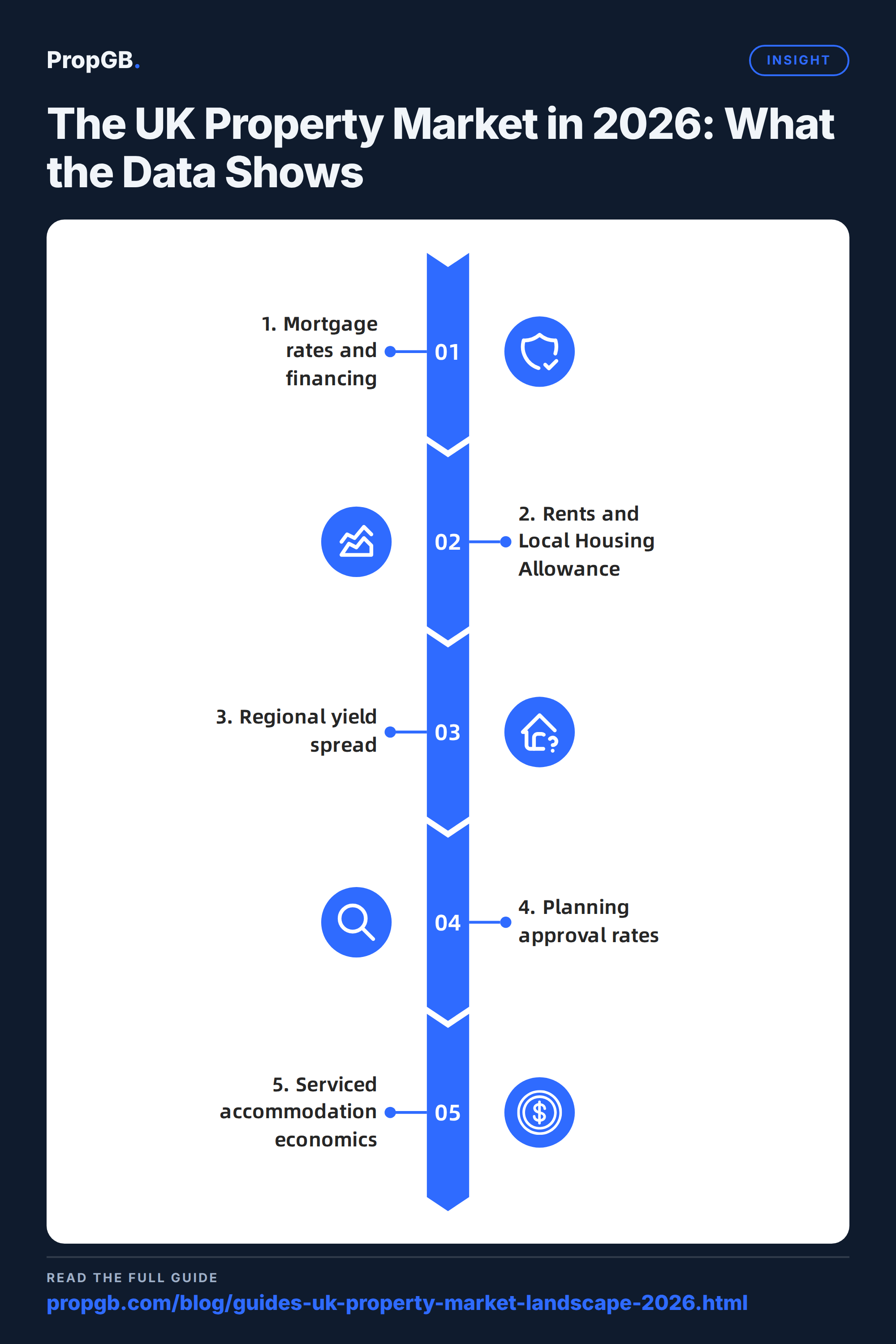
Every property decision starts with a number. This guide collects the numbers that matter most for UK property in 2026, rates, rents, yields, planning behaviour and the economics of different operating models, from public sources, and shows how they fit together. It is a data briefing, not a recommendation.
1. Mortgage rates and financing
Buy-to-let mortgage pricing in 2026 has been broadly range-bound. Working assumptions used across property analysis tools are typically a 5.5% interest rate on a 75% loan-to-value, with lenders applying debt-service-coverage requirements of at least 125% on stressed rates. That coverage test, more than the headline rate, decides how much can be borrowed: annual rent divided by the stressed payment needs to clear 1.25x.
Bridge and development finance sits higher, typically 0.6%–0.9% per month, and is a short-term tool, the cost compounds quickly, so holding periods matter more than the rate itself.
2. Rents and Local Housing Allowance
Local Housing Allowance rates were frozen at 2024/25 levels through to at least March 2027. The consequence is visible in the data: in many areas the LHA rate is now below market rents, in some cases by £150–£300 a month for the same property. That changes the strategy question. Rent-guarantee and social-housing routes (council block contracts, rent-deposit schemes) become a void and arrears play rather than a rent-maximisation play, while the best LHA-to-rent ratios in 2026 sit in areas like Cardiff, Grimsby, Teesside, Sunderland and Doncaster, where lower purchase prices keep yields in the 7.5%–8.4% range at the lower end of the price ladder.
3. Regional yield spread
Gross yields vary widely by region and price point. Analysis of current asking prices and estimated rents shows that lower-priced markets in the North East, North West and Wales routinely show gross yields above 8% at the bottom quartile of prices, while London and the South East typically sit between 3% and 5% at equivalent price points. Yield is a screening figure only, it excludes purchase costs, voids, maintenance and tax.
4. Planning approval rates
Planning is a leading indicator for conversion and development strategies. The latest quarterly figures across English local planning authorities show grant rates ranging from roughly 60% to over 90%, with a national picture where most authorities approve the majority of applications. In the West Midlands, recent quarterly grant rates were approximately: Dudley 76%, Birmingham and Sandwell and Walsall 83%, and Wolverhampton 91%. Delegated decisions, approvals made by officers rather than committees, make up a large share of the total in most authorities, which shortens decision timelines.
5. Serviced accommodation economics
Serviced accommodation (short lets, holiday lets, cottages) generates higher gross revenue per night than long-term letting, but the economics are occupancy-driven. Using real market data, average nightly rates in popular holiday towns range from roughly £150 to £300 depending on the property; a 40% occupancy is a commonly used UK market benchmark. The critical figure is break-even occupancy, the occupancy level at which revenue covers mortgage, platform fees, cleaning, maintenance and running costs. In high-rate coastal towns that figure can be below 15%; in lower-rate urban areas it can exceed 80%, which means the model only works at near-full occupancy.
6. Purchase costs and stamp duty
Stamp duty for an additional dwelling in 2026 uses bands of 0%, 2%, 5%, 10% and 12% with a 5% surcharge on all bands (capped at 17% in total). For a £150,000 purchase, that is £600 standard plus £7,500 surcharge; for £280,000 it is £4,000 plus £14,000. These figures should be itemised in every deal appraisal because they change the margin at the margin.
Putting it together
The practical takeaway from the 2026 data: financing costs are the biggest single variable in any deal model, LHA freezes have shifted the social-housing opportunity to specific areas, planning approval rates vary enough to change strategy by council, and serviced accommodation lives or dies on break-even occupancy rather than headline revenue. Run every scenario with itemised costs, then stress it.